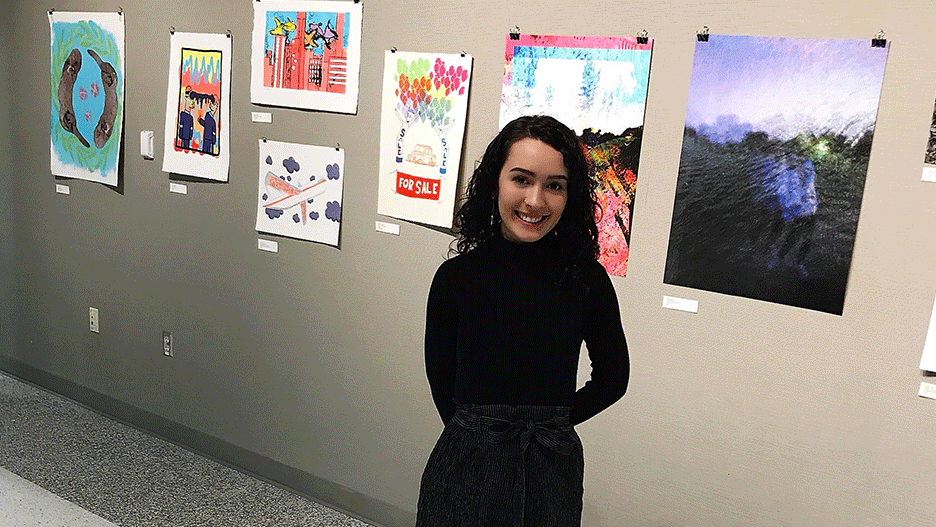
The Art of Folly was conceived, planned, juried, and installed by an advanced group of Studio Art and Art History graduate and undergraduate students at Minnesota State University, Mankato. Francisco Goya’s exploration of the follies of man and reality versus fantasy in his Disparates series c. 1824 was the inspiration for a national call for artworks. We are pleased to be exhibiting works by artists from several states alongside our point of departure, MSU Art Department’s Goya print, General Folly (c.1824). Responses to this theme are varied in subject matter and medium, and demonstrate a vast array of what “folly” can indicate in today’s society. Despite this broad range of interpretation—from artistic processes to mainstream consumerism, the artwork in this exhibition also mirrors many of Goya’s own investigations into subjects of confusion, anguish, and war, illustrating the ongoing relevancy of his work 182 years since his death.
In conjunction with The Art of Folly exhibition, a research group has compiled additional materials that provide background information on Francisco Goya and the period in which he lived, the Romantic era. A brief synopsis of this research has been incorporated here. For a more expansive account see (http://www.mnsu.edu/artdept/folly.html).
Throughout his artistic career, Francisco Goya created many paintings, etchings, lithographs, and print series. Born in 18th-century Spain, he was exposed to many different styles of art through teachers such as Luzan, and experiences such as his cartoon production and paintings of court life. He sustained a successful professional life through his royal connections and would eventually become the official court painter. Although his style was unique in that he painted non-idealized forms of people that conveyed personal attributes, his bold color and expressive use of line made his work a favorite over others. After a serious illness that left him almost completely deaf, Goya became disillusioned with political interests and withdrew from society and what he saw as the folly of man. During this time, he also became increasingly pessimistic and consumed with his own dark fantasies, which were reflected in his art. The print displayed in The Art of Folly exhibition is part of the Disparates series, which was created at this stage of his career. Following the Disparates series, Goya, frustrated with the Spanish political environment, entered into a self-imposed exile in France where he would create his most famous works, the “Black Paintings.”
Goya’s life’s work exemplifies the emphasis on emotion and folly in human nature, which was a preoccupation of the Romantic period. Romanticism was a reaction to the mechanical laws of nature and the modern science of the Enlightenment. It rejected the logical reasoning of the previous period and substituted it with imaginative, expressive qualities of humanity seen in Goya’s dark, reflective subjects and the expressive ambiguity of his style.
The influence of Goya’s work extends throughout the span of art history. His bold lines, colors, and emphasis on emotion can be seen in Surrealism and Abstract Expressionism. Although his style was not copied directly, his themes continue to have relevance today, as seen in the works of the Art of Folly participants.

----------------------------------------------------------------------------------------------------

----------------------------------------------------------------------------------------------------
----------------------------------------------------------------------------------------------------

----------------------------------------------------------------------------------------------------

----------------------------------------------------------------------------------------------------

----------------------------------------------------------------------------------------------------

----------------------------------------------------------------------------------------------------

----------------------------------------------------------------------------------------------------

----------------------------------------------------------------------------------------------------

----------------------------------------------------------------------------------------------------

----------------------------------------------------------------------------------------------------

----------------------------------------------------------------------------------------------------

----------------------------------------------------------------------------------------------------

----------------------------------------------------------------------------------------------------
----------------------------------------------------------------------------------------------------

----------------------------------------------------------------------------------------------------

----------------------------------------------------------------------------------------------------

----------------------------------------------------------------------------------------------------

----------------------------------------------------------------------------------------------------

----------------------------------------------------------------------------------------------------

----------------------------------------------------------------------------------------------------

----------------------------------------------------------------------------------------------------

----------------------------------------------------------------------------------------------------

----------------------------------------------------------------------------------------------------
Becky Carmody
Connie Derner
Alisa Eimen
Rosemary Fromm
Curt Germundson
James Johnson
Erik Waterkotte
Matthew Willemsen
Mackenzy Albright
Micheal Atwater
Samantha Beck
Lisa Friedrich
Lydia Hard
Kristin Harsma
Yoko Hattori
Ajay Kapadia
Christopher Kelly
Carl Mulder
Thomas Myers
Karen Obermeyer-Kolb
Angie Olson
Amber Phillips
Lauren Prine
Margaret Steck
Amanda Williams
Carnegie Art Center
Minnesota State University, Mankato Art Department
Cristina de Almeida
Valerie Frank
Francisco Goya
Gina Hunt
Colin Klimesh
Jon Knecht
Brian Krolak
Lou Krueger
Thomas Lane
Andy Mattern
Florence Alfano McEwin
Alex Miller
Lani Shapton
Holly Theobald
Patrick Vincent
Michael Weichmann
Everyone who submitted work

Francisco Goya was born in a small town named Fuendetodos, near Zaragoza, Spain on March 30.
He began a four-year apprenticeship with a local master, Jose Luzan. Following his apprenticeship, Goya headed for Madrid with the intention of winning a prize from the San Fernando Academy. Goya’s first commissioned work was a fresco in the Church of the Virgin in El Pilar in Zaragoza.
Goya spent several years working on frescoes throughout Spain. The most famous of these was created for the charter house, Aula Dei, near Zaragoza.
Officially named a painter in the Royal Court of Spain under King Charles III. During this time, he created roughly 65 cartoons for various rooms in several palaces, which were genre scenes in the Rococco style. The tapestry cartoons that Goya executed during this time became highly praised for their depictions of candid moments of Spanish lives. This time was very influential in Goya’s life as he spent much time watching people, their actions, emotions, and behaviors in order to create his genre scenes. These observations would allow him to demonstrate emotion and reality boldly in later works.
Goya was struck with an illness that left him completely deaf. As this left him cut off from the world, he was consumed with his own fantasies and grew to have a much more satirical world view. This was echoed in his work, which subsequently had a much more pessimistic air.
He began his greatest fresco project for the Church of San Antonio de la Florida in Madrid.
Goya published the Caprichos, which was a series of etchings satirizing human weakness and folly and mocking the social mores and superstitions of the time. Later series, such as Désastres de la Guerra (Disasters of War, 1810) and Disparates (Absurdities, 1820-1823), present more caustic commentaries on the ills and follies of humanity.
The artist completed Second of May, 1808 and Third of May, 1808 (both in the Prado Museum, Madrid). These paintings depict horrifying and dramatically brutal massacres of groups of unarmed Spanish street fighters by French soldiers. Both are painted, like so many later pictures by Goya, in thick, bold strokes of dark color punctuated by brilliant yellow and red highlights.
Goya began executing his most famous works, the “Black Paintings,” which contained dark and often grotesque imagery. Originally painted as frescoes on the walls of his country home, they have since been transferred to canvas and are now displayed in the Prado. The “Black Paintings” attest to his progressively darkening mood, possibly aggravated by an oppressive political situation in Spain that forced him to leave for France in 1824. While living in Bordeaux, Goya took up the art of lithography, producing a series of bullfights, which some consider the finest lithographs ever created.
On April 16th, Goya died in Bordeaux during a self imposed exile. He left no immediate followers, but his influence—characterized by bold line, colors and brushstrokes—was strongly felt in later expressionist movements. Surrealists have identified with his darker works, and Goya has also left a strong impression on 20th-century printmakers.