
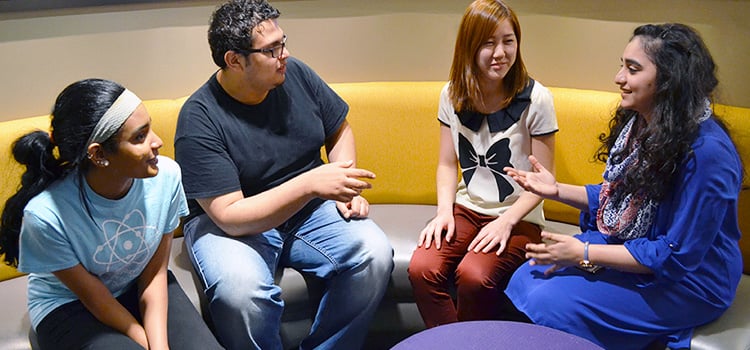

Honors faculty members are selected for their excellent reputations as scholars, teachers, and mentors. They enjoy creating innovative educational experiences and are dedicated to student success in and out of the classroom. In honors classes, professors demonstrate that knowledge is not something merely to master, but also to wield. There are no closed discussions, no memorization lists. Rather, information is uncovered, shared, and used as a tool by students in their ongoing journey of discovery.
Dr. Cole received her Ph.D. in Rhetoric and Composition from Arizona State University in 2008. She is currently working as an Assistant Professor in the English Department. Dr. Cole leads faculty development seminars on writing intensive classrooms, teaches rhetorical theory and methodology, and researches women's activist rhetoric. She has a book forthcoming from Edward Mellon Press entitled, "The Consideration of an Effect: Gothic Cliché as Romantic Object in the Texts of Edgar Allen Poe," as well as an article entitled "Feminist Social Projects: Building Bridges between Communities and Universities," in College English. Dr. Cole has also edited a volume of thirdspace, an online feminist journal.
Dr. Cooke began his college education in electrical engineering, and ended up with degrees in mathematics and music, and a certificate in East Asian studies. After graduation, he went to Japan to teach English, returned to the States and the University of Maryland, where he took philosophy courses and worked fulltime. He completed his Ph.D. in philosophy at St. Andrew’s University in Scotland. His dissertation on the nature of aesthetic value argued that while what we experience in works of art is partly the construct of our imagination, we can nonetheless make objectively true judgments about artworks. My musical background turned out to play a big role in my work as a philosopher. Before coming to Mankato in 2005, he taught for a semester at the University of Maryland and for three years at Auburn University. He recently spent a year on a teaching fellowship at Lingnan University in Hong Kong, where he met his wife.
Dr. Corley studied History and Philosophy at Bloomsburg University, where he was also an honors student. He earned an M.A. and Ph.D. in European History from Purdue University. He teaches first-year courses on preindustrial European history (from Classical Greece to the Reformation), and advanced courses on early modern (c. 1300-1800) social and cultural history. His specific teaching and research interests include the history of women, gender, the family, and young people in early modern Dijon, France. He has received research and teaching grants from Bloomsburg University, Purdue University, Minnesota State, Mankato, the University of Paris-IV, and the American Historical Association. His published research has appeared in the Journal of Family History, the Journal of Social History, The History Teacher, and The Journal of the National Collegiate Honors Council. Corley has presented his research at national and international conferences, including those held in France, Sweden, Canada, England, and Northern Ireland. He has supervised the work of twelve undergraduate and four graduate students who have presented their work at research conferences.
Dr. Eimen studied Art History and German at the University of Alabama, Birmingham. She earned an M.A. and Ph.D. in Art History from the University of Minnesota, where she specialized in Islamic and South Asian studies. While completing her Ph.D., she also earned an M.Phil. from the International Institute for the Study of Islam in the Modern World (Leiden, Netherlands) and completed a year-long curatorial internship at the Walker Art Center in Minneapolis. She has been teaching Art History at Minnesota State University since 2005, covering a range of topics from ancient to modern art around the globe. Her research interests focus on the ways in which identity and memory shape art and architecture. Her most recent publications are chapters in Performing the Iranian State: Visual Culture and the Representations of Iranian Identity (Anthem, 2013) and Making Art and Architecture in India: Woman’s Eye, Woman’s Hand (Zubaan, forthcoming in 2013). She will be on sabbatical in 2013-2014, researching development of Muslim sacred space in Germany.
Dr. Filipovitch is Chair of the Urban and Regional Studies Institute. He was also Dean of Graduate Studies and Research for five years. Tony was born in Chicago and raised in Detroit (although he also spent his summers on his grandfather's dairy farm in Wisconsin). He earned a BA in Psychology (teaching minor in French) from the University of Michigan, and his MA in Phenomenological Psychology from Duquesne University. After three years of teaching inner-city adults for Allegheny Community College, he completed his Ph.D. in Urban Studies at Portland State University. He came to MSU in 1978, after teaching for three years at the University of Tulsa. In his time in Mankato, he has served on the boards of a number of community organizations, including the YMCA, Citizens' Voices, Envision 2020, the Mankato Area Foundation, the Region IX Arts Council, the Mankato Planning Commission and the Mankato Historic Preservation Commission. He also served on the Board of Directors for the national Urban Affairs Association.
Tony's initial research focus was on the impact of city living on child development. Over the years, he has published three books (Urban Community, Introduction to the City, and Urban Analytical Tools) and articles on nonprofit organizations and civic engagement. He is currently working on an inventory of the nonprofit sector in Ghana with colleagues from Kwame Nkrumah University in Kumasi, Ghana and he is helping to establish a center for modeling and simulation at Minnesota State Mankato.
For fun, he has served as a Great Books facilitator for elementary school children, led a Latin Club for middle-school children, and does one-man performances as Thomas Jefferson and Vitruvius Pollio (the Roman architect). In his spare time he works on his garden and his 1880s-era farm house. And he practices yoga, to recover from all that activity.
Dr. Hunter is an Associate Professor in the Sociology and Corrections Department, where she has been a faculty member for five years. She received both her bachelor's degree and her Ph.D. from Kent State University in Ohio. Notably, she was a valedictorian and Mortar Board Scholar of her undergraduate class in 1997. As a graduate student, she served as a research fellow for Manpower Demonstration Research Corporation, a national poverty institute. In this position, she worked as a project manager at one site of a national study on welfare reform policies. Her areas of specialization include psychology, social inequality, research methods, family violence, gender, and women's experiences exiting prison. She and her colleague, Dr. Kimberly Greer, are currently conducting a longitudinal study that follows individual women leaving prison over a period of 4 years after their release from prison in order to gain a better understanding of the social and personal experiences of re-entry for women. She also teaches an interactive college course within a prison setting that brings together students from Minnesota State Mankato with students in the educational program at the prison.
Dr. Kerr-Berry is a Professor and Dance Program Director at Minnesota State University, Mankato. As a founding member of the National Dance Education Organization (NDEO), she was Editor-in-Chief of its official journal, the Journal of Dance Education, for nearly a decade. Her writing focuses on critical pedagogy in dance education and its relationship to the arts, humanities, and feminist pedagogy. Dr. Kerr-Berry has presented her research at such conferences as NDEO and the National Association for Africa American Studies. In the early 1990s, she devised a self-study, which led her to Nigeria where she also taught. Later she was a recipient of a Fulbright Scholarship to study dance in Indonesia. Dr. Kerr-Berry earned her master and doctorate degrees in Dance from Temple University in Philadelphia. In the fall of 2010, she was awarded an Outstanding Leadership Award in dance education from NDEO. In 2011, she received a Top Paper Citation from NDEO for a paper she wrote and presented at their 2010 conference. It will be published in 2012.

Dr. Kipp received a B.A. in Physics and Astronomy from the University of Virginia in 1970. He received a Masters in astronomy from Wesleyan University in 1977 and his Ph.D. in astronomy from the University of Pittsburgh in 1980. He worked as an astronomer in Venezuela for a year before coming to MSU. He has worked at MSU to create and operate Andreas Observatory with the second largest telescope in Minnesota. His interest in pseudoscience arose from the publicʼs confusion of astrology and astronomy.
Dr. Lassonde is an Associate Professor of Psychology with a speciality in Cognitive Psychology. She also received a master's degree in college teaching while pursuing her doctoral studies. Her research focuses on human memory and attention, and can be applied to student learning in the classroom. She has found that teaching presents itself as an applied setting that feeds into her intellectual creativity and research agenda. She is passionate about the research process and enjoys mentoring undergraduate research students. She hopes to comvey the importance of learning through shared meaning. As topics are explored in the classroom, she aims to demonstrate that learning is dynamic and reflective, a process she identifies as "recriprocal learning." In addition to focusing on student learning, she hopes her enthusiasm to pursue topics of psychology and her efforts to improve teaching for her students model a life-long approach to learning. This dynamic relationship of teaching and learning accomplishes shared meaning in the classroom.
Keith Luebke is Associate Professor in the Art Department and Director of the Nonprofit Leadership Program. He graduated with an MFA in Art from Southern Illinois University at Carbondale. He has been teaching Introduction to Visual Culture since 1985, but also worked in the nonprofit sector for more than twenty years. Nonprofit experiences include managing a grant program for a foundation, creating housing and supportive services for homeless and very low income families, and directing arts programs. He spent his first sabbatical volunteering at the nonprofit A:shiwi A:wan Museum and Heritage Center, Zuni Pueblo, New Mexico. His interests include social inequality, postmodern architecture, the sociology of art, and emerging media.
Dr. Martensen receiving his BA at the University of Texas, he earned his MA and Ph.D. in Mathematics from Montana State-Bozeman in 2001. Dr. Martensen’s research focuses on modeling with differential equations, and topological methods in dynamics and tiling space theory. He has taught at the University of Texas, the University of Montana-Bozeman, and Rose-Hulman Institute of Technology. He has served as a mentor for several undergraduate research projects, and he has served on a wide variety of university committees. He currently is chair of the Department of Mathematics.
A native of Kenya, Dr. Odinga received B.Ed. and M.A. degrees from Kenyatta University in Nairobi and her Ph.D. in History from the University of Minnesota. She also recently earned an MBA from the University of Minnesota’s Carlson School of Management. Dr. Odinga has taught courses on World History and Sub-Saharan African History in Kenya, at the University of Minnesota, Hamline University, and here at Minnesota State since 2007. She has received numerous grants for her research on women and medicine in twentieth-century Kenya. She has been extremely active in the Twin-Cities East African immigrant community and has presented aspects of her research at numerous community forums throughout the state.
Dr. Paul Prew’s research and personal interests all revolve around the growing concerns regarding the destruction of our environment. Of particular interest is how these environmental threats are forcing changes in indigenous groups as well as in poorer nations around the world. To get a first-hand look at these issues, Dr. Prew has traveled to Ecuador to learn from an indigenous group, Sarayaku, and other groups who resist environmental degradation and threats to their livelihood.
Dr. Prew is a local Midwesterner, living most of his life a mere four hours drive from Mankato. After receiving a Bachelor’s degree from the University of Wisconsin-La Crosse, he received his Masters in Sociology from MSU-Mankato when it was still Mankato State University. Dr. Prew returned to teach at MSU-Mankato after his PhD program at the University of Oregon where he specialized in environment, Marxist theory and labor studies.
Dr. Sheffer has taught Creative Writing at Minnesota State Mankato since 1980. He earned a BA and Doctorate of Arts from SUNY Albany. His short stories have appeared in three collections, the latest in 1999 in Music of the Inner Lakes from New Rivers Press. His most recent magazine publication was a story in the summer 2007 issue of Harpur Palate, and was a finalist for the John Gardner Award.
Dr. Schirmer is an Associate Professor of Anthropology, and completed his Ph.D. in Archeology in 2002 at the University of Minnesota, with a doctoral minor in Quaternary Paleocology. Ron's research focuses on examining the interrelationships between people and the environment, especially as those relationships become characteristic in specific cultures and then are used as markers of identity when different groups of people interact with each other. He researches throughout the southern half of Minnesota, with foci in the Mississippi and Blue Earth valleys. In addition, he works with several Native American groups in Minnesota and Wisconsin on archaeological site preservation and community outreach to give descendent communities greater voices in research and preservation.
Dr. Sekimoto earned her Ph.D. in Communication Studies from the University of New Mexico in 2011. As an Assistant Professor in the Department of Communication Studies, she teaches courses related to intercultural communication. In her teaching, she focuses on issues of globalization, racial and ethnic diversity, cultural identity, critical literacy, media representation, and social justice. In her research, she is primarily interested in theorizing the relationship between culture and communication through critical, feminist, and phenomenological perspectives. She is originally from Tokyo, Japan.
Dr. Stark earned her Ph.D. in Social Psychology from the University of Minnesota in 2007, and then joined the Psychology Department here at Minnesota State University, Mankato. Her research interests lie in understanding the things that influence our judgments and decisions, such as emotions, logical reasoning, personality traits, the context of the decision, and other factors. She is also involved in several research projects tied to understanding how students learn and how to motivate better study habits, as well as how to improve students’ critical thinking abilities.
Dr. Stitt studied English Literature and Women's Studies at Pomona College in California (B.A.) and postcolonial literature at the University of Edinburgh in Scotland (M.Litt) before beginning her doctoral work. Stitt's experience as an undergraduate at a liberal arts college that emphasized small class size and discussion-based seminars convinced her that she wanted to be a professor. She is looking forward to teaching similar seminars in the Honors Program.
Stitt is an Associate Professor of Gender and Women's Studies where she teaches courses on global feminism, postcolonial culture and theory, and feminist mothering. She received her Ph.D. in English and Women's Studies from the University of Michigan and has held fellowships at the Institute for the Humanities at Michigan and the International Museum of Women. Her publications investigate the intertwining of the familial and the imperial in Britain and the Anglophone Caribbean from the nineteenth century to the present, in journals such as Small Axe: A Journal of Caribbean Criticism and ARIEL. She coedited with Pallavi Rostogi Before Windrush: Recovering an Asian and Black Literary Heritage within Britain (2008). Stitt and Pegeen Powell co-edited Mothers Who Deliver: Feminist Interventions in Public and Interpersonal Discourse, which will be published by SUNY Press in September 2010.
Dr. Gina Mumma Wenger is a Professor in the Department of Art. Dr. Wenger began her career as a public school art educator and administrator, completing a BA and MA in Art Education and receiving a doctorate from Penn State University in Art Education. Her research focuses on contemporary issues in curriculum and teaching with an emphasis on feminist pedagogy and critical theory. Dr. Wenger’s current writings investigate the history of art education within the Japanese American Internment Camps of WWII. She has constructed a photo documentary of the camps as they stand today and the children’s artworks created within the camps.
Dr. Westerman is a Professor in English and the Director of the Humanities Program. She studied English and Philosophy at Oklahoma State University, where received her B.A. and M.A. in English. She earned a Ph.D. in English from the Univerity of Kansas and her dissertation focused on discourse analysis and the design of human-computer dialogue. At MSU, she teaches technical communication, literature, and humanities courses at undergraduate and graduate levels. An artist and poet, she is enrolled member of the Sisseton-Wahpeton Dakota Oyate, and incorporates the languages and traditions of her family in her writing and art. She is the author Follow the Blackbirds, a poetry collection in Dakota and English, and co-author of Mni Sota Makoce: Land of the Dakota, a history of Dakota land tenure in Minnesota.
Dr. White earned a B.A. in Communication and English Writing from Concordia College in Moorhead, Minnesota, a M.A. in Speech Communication from Kansas State University, and a Ph.D. in Communication from Arizona State University. Her research focuses on performance studies, rhetorical theatre and criticism, and feminist theory, and she has completed many professional development workshops on theatre and performance pedagogy. She has served as the Chair of the Communications Studies Department and is the Director of the Forensics Program.