
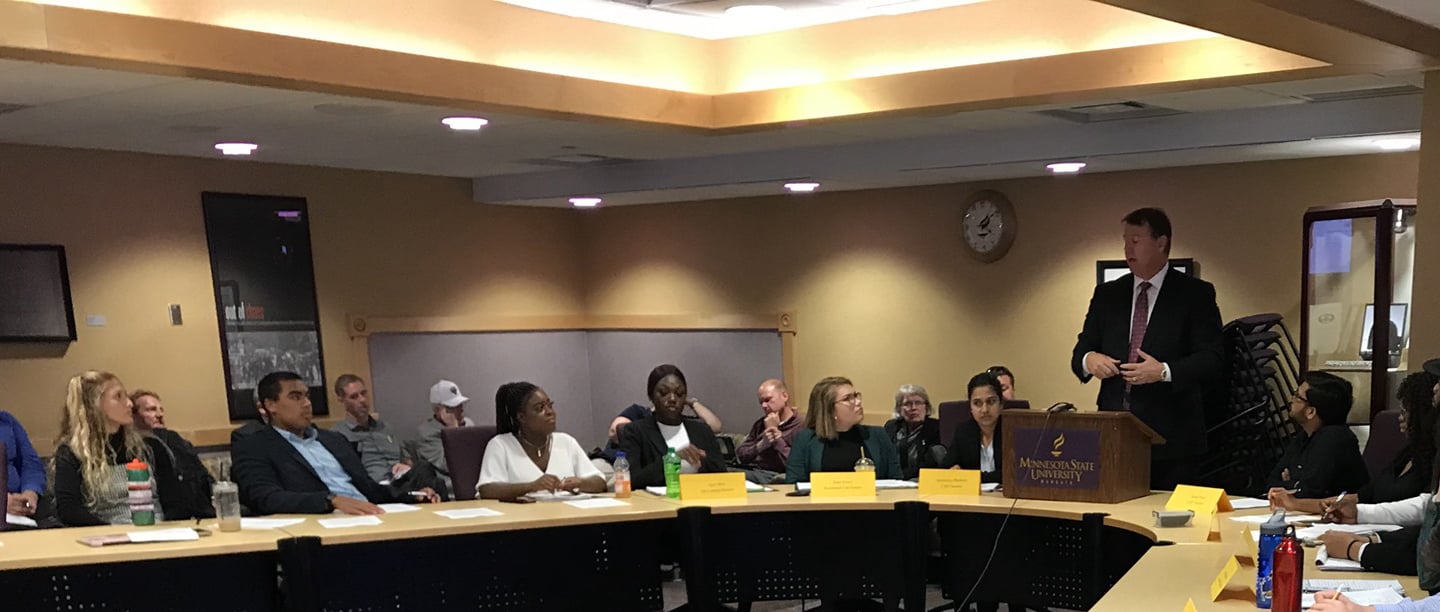
The Minnesota State University, Mankato Student Government represents all students at the Institutional, Local, State and Federal governing levels through listening to and voicing the thoughts, ideas, and concerns of all students. We are the direct student representation and official voice to the University Administration. Join us every Wednesday at 4:00 p.m. in CSU 238. Meetings are open to all students, staff, faculty and public.
Student Government Live Stream
Watch live Student Government meetings or view past meetings via the on-demand section.
Contact Student Government
Minnesota State Student AssociationMinnesota State University, Mankato
Centennial Student Union
Mankato, MN 56001Office Location: CSU 280
Phone: 507-389-2611
800-627-3529 or 711 (MRS/TTY)
State-Wide Student Government
Statewide association for four-year Minnesota State college and university students.
To make a contribution to Student Government at Minnesota State Mankato: Select “More Giving Options”; Check the box for “Student Affairs Division"; Indicate “For Student Government” in the Gift Instructions. Donate Now
Sponsored Services
The Student Government makes several services available to students and you are encouraged to make use of them as the need arises.
Student Government Information
The Student Government Constitution, ByLaws, Senate Operating Policies, and Meeting Minutes describe how Student Government represents Minnesota State University, Mankato students at the Institutional, Local, State, and Federal governing levels.
Student Activity Fee Allocations and Budgets
Under the Student Government Constitution the Student Senate plays a central and determining role in the adoption of the fee schedule and the allocation of $2.6 million in Student Activity Fee receipts to various programs.
Student Government Elections
The following candidate guide, election rules, and latest election results for Student Government are available for your review.
Student Government History
Past Leadership and Historical Meeting Minutes.
Awards and Scholarships
Each year Student Government recognizes a number of students and staff members for their achievements.
Contact Student Government
Contact Student Government.