For nearly 160 years, Minnesota State University, Mankato has prepared students to lead, serve and strengthen Minnesota’s workforce, economy and communities. Today, the University faces a projected $22 million budget shortfall for the 2026-2027 biennium. Addressing this challenge requires difficult decisions. By acting now, we can protect our academic mission, support our students and position the University for long-term sustainability and strength.
Our responsibility extends beyond balancing a budget. We must ensure that Minnesota State Mankato continues to provide an exceptional, accessible education for generations to come.
MSU’s impact is clear.
- We educate more than 18,000 students each year.
- We award nearly one-third of all bachelor’s degrees in the Minnesota State system.
- We produce 40% of the system’s graduate degrees.
- More Minnesota students choose MSU than any other public university except the University of Minnesota Twin Cities.
- We have been voted Minnesota’s best university in the Star Tribune’s Reader’s Choice Poll for six consecutive years.
Understanding the Budget Challenge
Minnesota State Mankato has managed its resources responsibly and operates at a lower cost per student than any of our peers. Nevertheless, our expenses are rising faster than our two primary sources of revenue: tuition and our state funding allocation.
The result is a projected budget gap of approximately $22 million over this biennium. There are several interconnected factors that have contributed to this imbalance.
State support has not kept pace with costs.
The Minnesota Legislature once committed, by statute, to funding at least 67 percent of a student’s cost of attendance, with tuition covering the remaining cost. Today, state funding supports one-third of the cost of attendance at Minnesota State Mankato, resulting in a need to increase tuition significantly. At the same time, the costs of delivering a high-quality education, including compensation, benefits, technology, utilities, student services and infrastructure, continue to rise.
The state faces a projected deficit for the next biennium, and legislators have a difficult task to balance the many needs of the state with relatively few resources. This means that any significant increase in higher education funding appears unlikely in the near term.
Lowest state support per student.
The Minnesota State system distributes its state appropriation among its 33 colleges and universities. The system’s allocation strategy focuses on ensuring access and supporting each campus's operations. With this strategy, institutions that generate more tuition revenue receive a lower share of state appropriations. As the state's second largest university, MSU brings in more tuition revenue than other system institutions. This means that for fiscal year 2027, the average state allocation per full-year equivalent student for the seven system universities is projected to be $6,183; MSU will receive $4,574. The $1,609 per student gap is more than we can reasonably ask tuition to cover.
State Support per Student Fiscal Year 2027
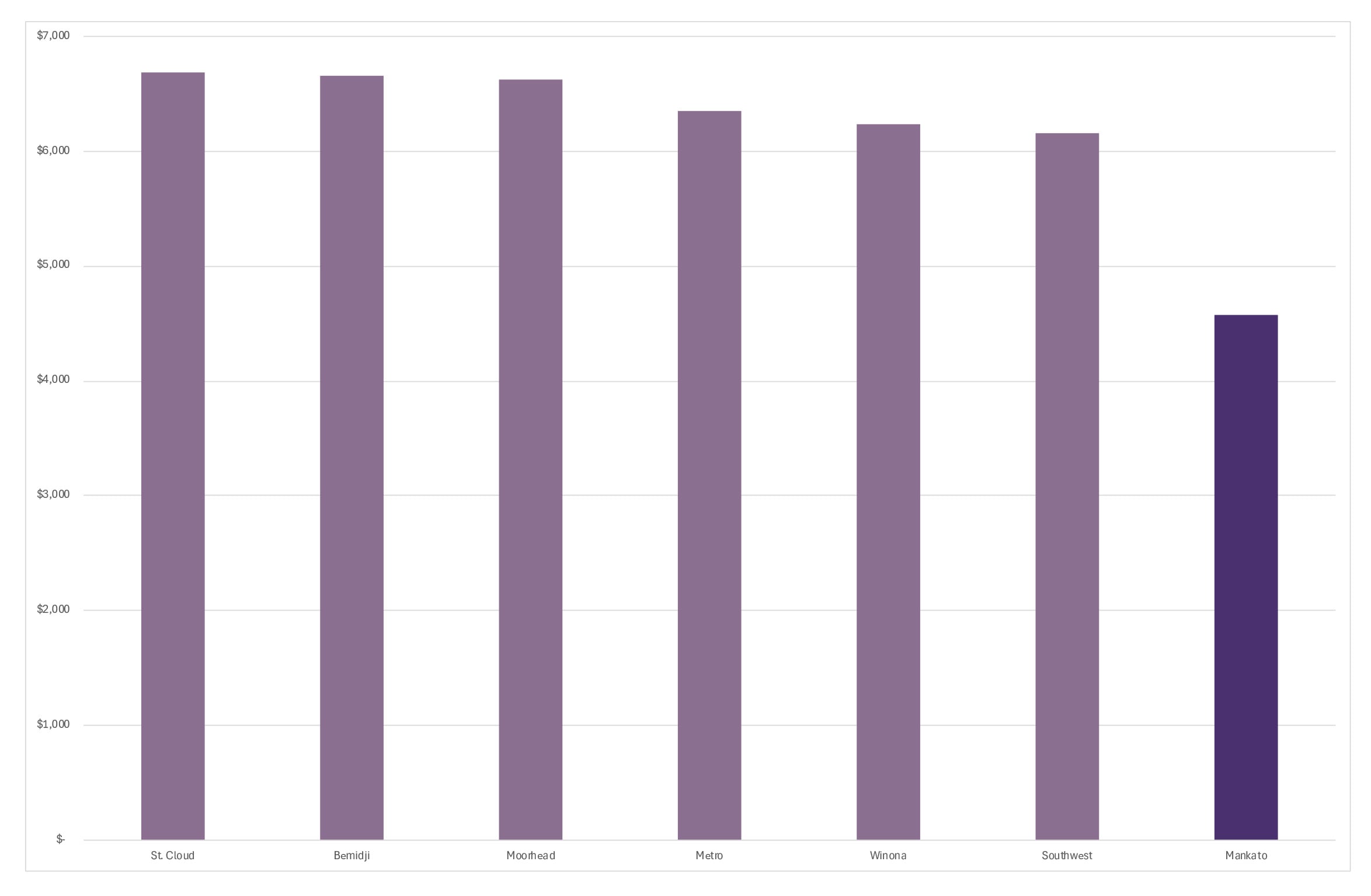
Source: Minnesota State Financial Planning & Analysis
Enrollment is not the problem.
Enrollment at Minnesota State Mankato remains near historic highs. In fiscal year 2026, MSU’s full-year enrollment headcount was 18,651. Students continue to choose us because of the impactful, engaging education we provide, the community connections we cultivate and the vibrancy of our campus. However, enrollment growth and tuition increases alone cannot solve our financial challenges.
For more details about the University’s financial situation, watch Vice President Anne Gillespie’s presentation at the April Faculty and Staff Town Hall virtual meeting.
Financial Presentation (video)
Our Commitment
As we address this challenge, our decisions will be guided by several commitments:
- Protect the quality of the student experience and our academic mission
- Preserve access to the programs and services students need to succeed
- Use resources responsibly and pursue efficiencies wherever practical
- Consider the long-term effects of decisions, not only immediate savings
- Engage employees, students and University partners in the process
- Communicate decisions, timelines and progress as clearly as possible
By taking responsible action today, we can ensure that Minnesota State Mankato continues to transform lives and strengthen Minnesota for the next 160 years.
Explore Decisions for Financial Sustainability and Future Investment