
A Century in Ink
September 15, 2026
Published In: Today Magazine
Alumni and mentors reflect on the value of the campus newspaper to the students and the University.
By Amanda Dyslin ’03, '15
Growing up in Milwaukee, Wisconsin, Myron Medcalf watched his dad sit down on Sundays with the newspaper, letting each section fall to the floor as he finished reading. Medcalf waited for his favorite sections—sports, comics and even ads—to float down to the discard pile so he could take his turn.
“Then I would just devour it. I fell in love with journalism because my dad loved it,” he said.
A dream of working for ESPN grew from those roots, and Medcalf came to Minnesota State Mankato in 2001 to play football, run track and major in mass communications. He decided to write for The Reporter, the campus newspaper, to gain some practical experience. At his first story-assignment meeting, once again he found himself waiting for sheets of paper to fall to the ground.
“They would have 20 different stories, and they would just throw them on the ground and say, ‘Grab one you think is interesting, and you can run with it,’ and it was like being in a toy store,” he said, recalling his first story covering a cross-country meet in the pouring rain, interviewing athletes with a soggy notebook. “It wasn’t a great experience, but the thrill was so amazing to me. I got such an adrenaline rush out of this idea that I could go and talk to people, write their stories, and that someone might read about it. Like, all of a sudden, I had this significance in the world.”
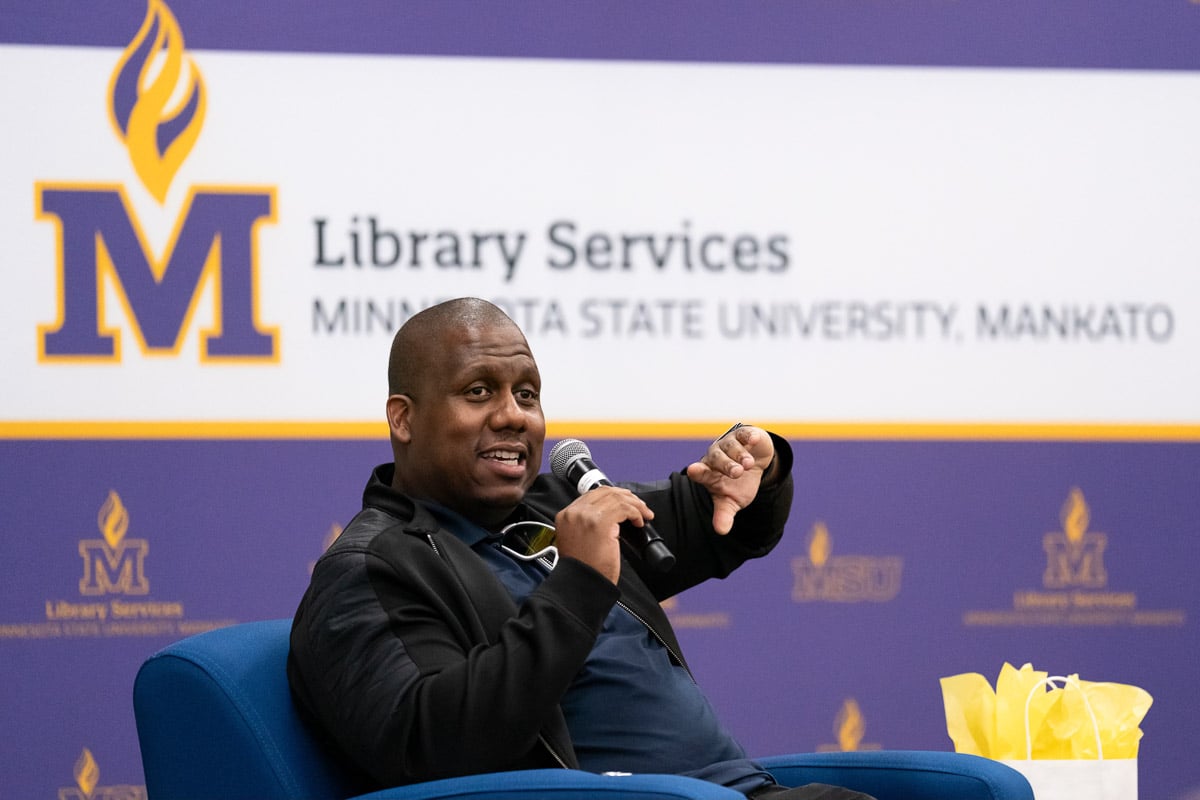
Twenty-five years later, Medcalf—who went on to become The Reporter’s first black editor-in-chief, a Star Tribune writer and columnist, and a reporter with ESPN—talked about these stories like they were yesterday at the newspaper’s 100th anniversary celebration in March. And as he did, he looked out at the knowing expressions of dozens of Reporter alumni from across the decades whose memories of the paper were felt with that same aching nostalgia.
Classroom Without Walls
Like so many others, the decision to join The Reporter changed Medcalf’s life, he said. “I learned how to be a journalist at The Reporter.”
That sentiment—repeated in different ways across generations—is the clearest measure of The Reporter’s value. For 100 years, the student-run newspaper has been a proving ground, a classroom without walls and a living record of the campus itself.
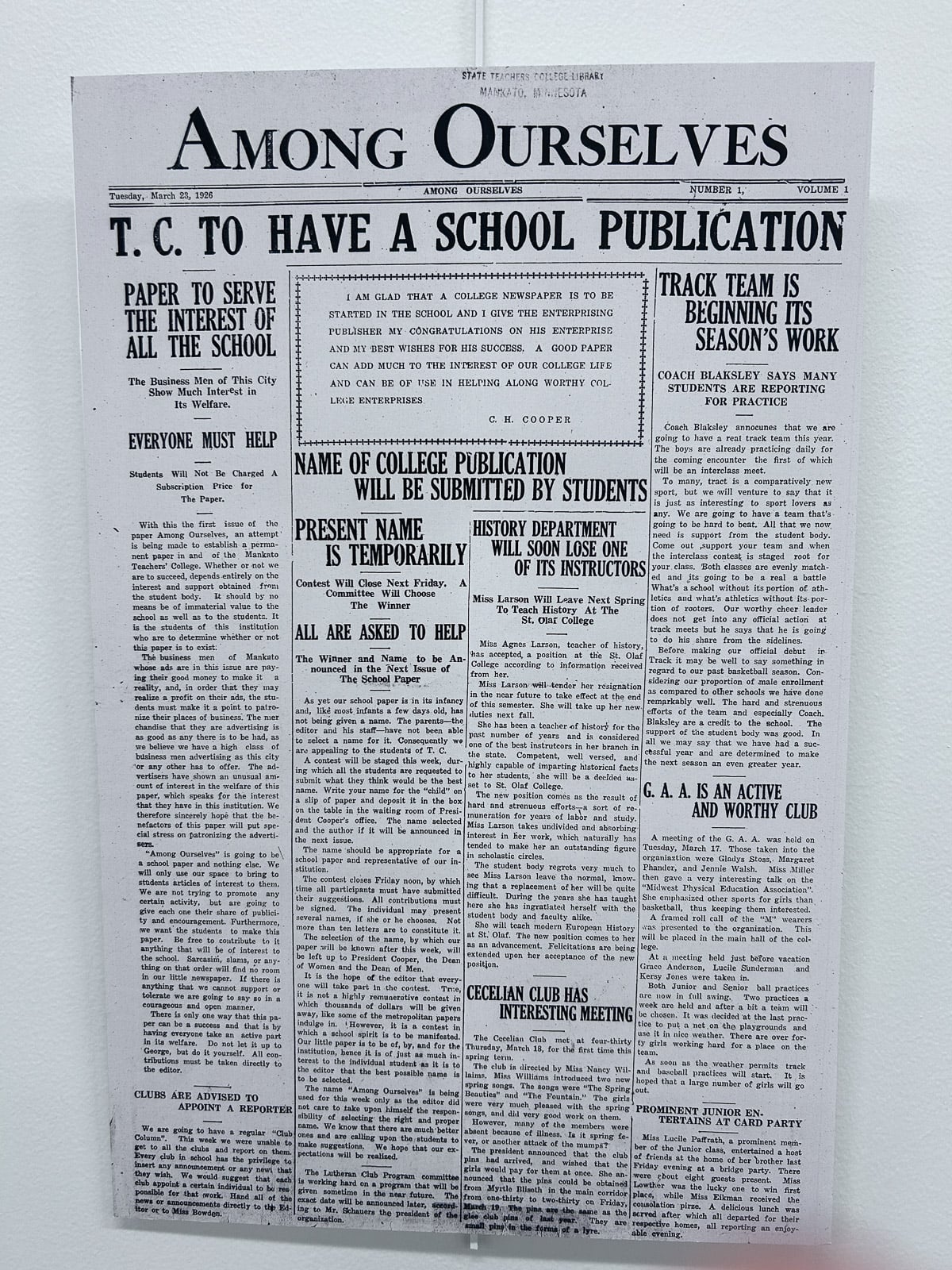
First published on March 23, 1926, under the name Among Ourselves, The Reporter has evolved alongside the University and the profession it feeds. Ellen Mrja, a retired mass media professor who mentored generations of student journalists from 1982 to 2019, watched the paper grow and change, evolving with the ever-emerging modes of multimedia storytelling. But she said the core has remained intact: students telling the story of their campus in real time.
“It’s extraordinary that Minnesota State Mankato has a student paper that’s been running for 100 years,” she said.
Mrja says that it’s been fascinating to watch the tone of The Reporter change annually with each new leader. Some years were calm, peace-keeping years. Others were fractious, with editors pushing back against student government or administration. One of Mrja’s favorite editors, Tim O’Brien, became legendary for doing exactly that. Under his leadership, the paper once ran a banner headline declaring independence from the Student Senate, which he believed shouldn’t have oversight or influence over The Reporter because the paper covered the senate.
“He fought more and harder than any editor I ever saw,” Mrja said. “But he was watching out for the students.”
O’Brien served as editor from 1989 to 1990 and went on to work as a copy editor and editorial writer at the Star Tribune for 16 years. He described his time at The Reporter as both professionally and personally formative. He took his role seriously, he said. He wanted his team to do real journalism that had real stakes, like publishing stories about the lesser salaries of female professors on campus compared to their male counterparts.
“There’s an idealism that is inherent in college kids, and we really thought that we were the next Bob Woodwards, Carl Bernsteins, Ben Bradlees,” O’Brien said. “And so we were always looking for the big story and to worry (former president) Margaret Preska every Tuesday and Thursday morning about what was going to be in the paper.”
Like it did for so many others who worked there, The Reporter gave O’Brien clarity. It was where he discovered not just that he could be a journalist, but that he wanted to be one and set the course for everything that followed.
That kind of discovery happens not just in big moments, but in the daily rhythm of newsroom life, which Jane Tastad witnessed countless times over 42 years serving as business manager of The Reporter and unofficial den mother to “her kids.” She loved watching the way the experience shapes students. Many find friendships for life, and the boost professionally after college is huge.
“I hardly ever see an ad rep graduate that does not already have a job laid out and ready to go,” said Tastad, who retired in June. “They go in already 10 steps ahead of everybody else."
The Same Purpose
Whether graduates pursue journalism, marketing or something entirely different, Tastad and Mrja said students learn how to communicate, meet deadlines, and navigate real-world expectations at The Reporter. They also simply love being there, working together until the early hours of the morning on production nights and bonding over a shared desire to do good work.
“I mean, it was just one year. You don’t think that one year is going to change your life that much. But that year, really, it changed me as a person, as a leader, as a friend, as a journalist,” O’Brien said. “Yeah, I’m really proud of that year I was editor. We were like, ‘We are The Free Press. We are the Star Tribune. You treat us the same way because we have the same purpose.’”
The 2025-26 centennial year was led by editor-in-chief Anahi Zuniga, who’s especially proud of the paper’s coverage of the U.S. Immigration and Customs Enforcement’s (ICE) impact on students during its heightened presence in Minnesota over the winter.
“I reported at a protest where I spoke to five students who weren’t afraid to express their opinion, who weren’t afraid to express their voice,” said Zuniga, who’s considering a career in journalism instead of publishing due to her time at the paper. “And that gave me a sense of not only pride for myself for writing this story, but for them because they weren’t afraid to speak up.”
As print editions for newspapers across the country become increasingly rare, Zuniga also has worked to expand the paper into more digital avenues of storytelling. She, O’Brien and Medcalf all remarked that the platform has and will change, but the mission never will.
“We’re the news,” Medcalf said. “What we will have left is what we contributed to this world, and a big part of that, no matter what anyone tells you, will be the written word.”
A Legacy Living on for Future Peacekeepers
After alum and police Matthew Ruge was killed in a domestic violence standoff, his family honors his memory with a law enforcement scholarship. By Robb Murray ’96
Finding the CURE
Finding the CURE. Program Gives Undergraduate Researchers More Opportunities. By Grace Brandt '13.
A Reputation Here, There and Everywhere
A Reputation Here, There and Everywhere. From the air above to business below, Minnesota State Mankato enjoys a widespread reputation across disciplines and across borders.