Minnesota State University's property totals 354 acres including 77 acres of protected ravine areas. For more information contact Facilities Planning at 389-2226 or facilities-planning@mnsu.edu. For pictures and more details visit MSU's Campus Tour.
Please click on the images below to display a bigger image.
![]() |
The MSU Mound
In an effort to enhance the corner where Blakeslee Stadium is located, a giant mound was created in 2001 to provide yet another aesthetic treatment of the campus grounds. |
![]() |
The Fountain
The fountain, design of which came from part of the New York City World Fair (1965), was installed in 1969. It was designed to create a spiral effect with stationary water jets. The sculpture in the fountain was not originally part of the work. The sculpture, by Roger Johnson, a former faculty member in the Art Department, was added in 1975 |
![]() |
The Marso-Schmitz Plaza Made possible by a lead gift from MSU Foundation president Mary Marso-Schmitz ('68), creates a place for students to relax, study, and meet others. Its design allows for outdoor music performances, as well as community and University events and receptions. |
|
Jane Rush Gathering Place
The Jane Rush Gathering Place was created to honor the late Jane Rush's contributions to campus life. Features include an arbor, which is located over the western sidewalk of the plaza, and a small cupola located in the arbor's center. |
![]() |
Around the World on the 44th Parallel (Memorial Library) In three sets of four panels each, Joyce Kozloff depicts cities located near the 44th parallel around the globe. Each four by seventeen-foot panel is composed of foot-square ceramic tiles applied to the wall surface with an adhesive. The project was commissioned through the Minnesota Percent for Art in Public Places, sponsored by the Minnesota State Arts Board. The work was created at the Tile Guild in Los Angeles and installed in Memorial Library in June 1995
|
![]() |
Ostrander- Student Memorial Bell Tower
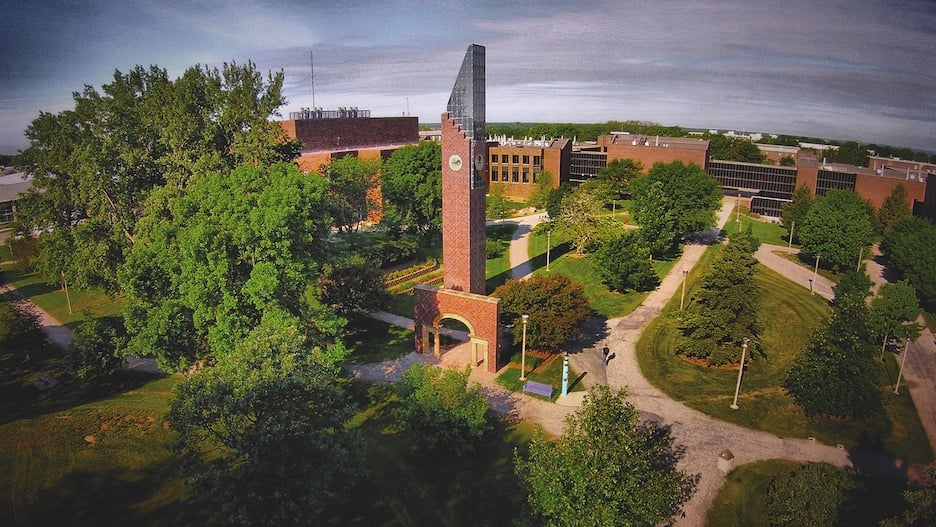
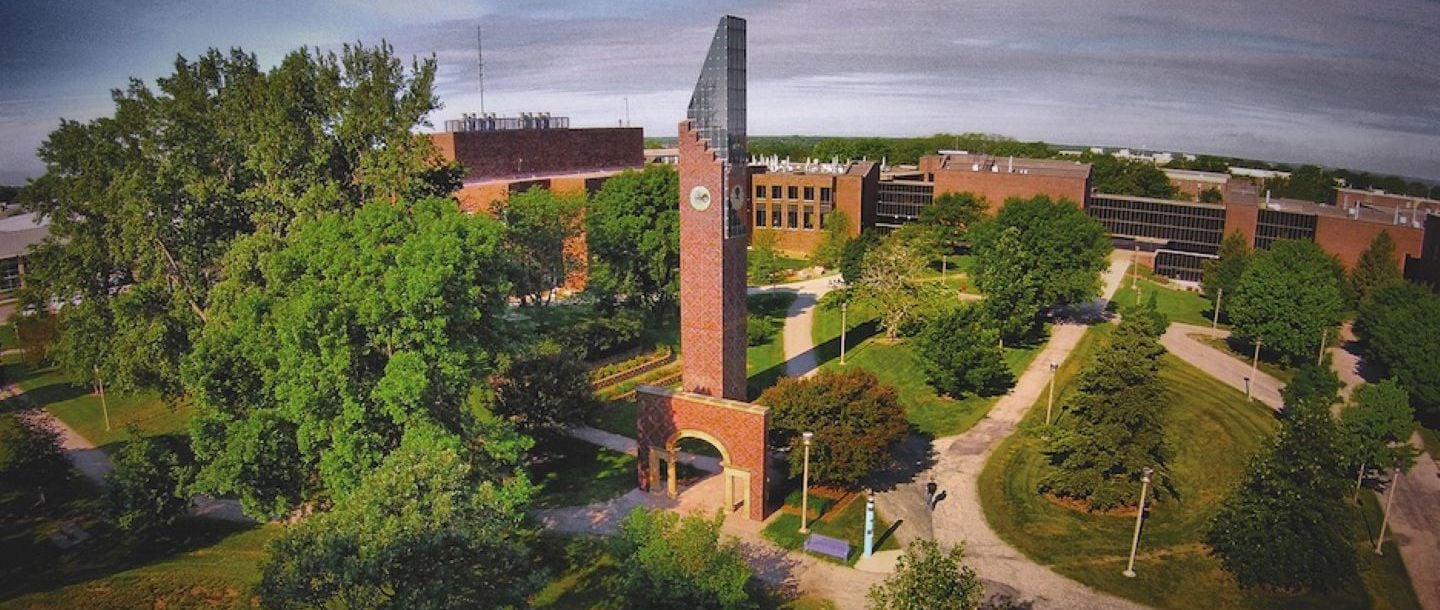
The Ostrander-Student Memorial Bell Tower stands in the MSU campus arboretum. Its construction was made possible by a gift from Lloyd B. Ostrander, a 1927 MSU graduate, his wife, Mildred, and donations from the MSU Student Association and other contributors. The Bell Tower, with its clock, was completed in 1989. Though known as the "bell tower," no bells exist and the music provided is from a carillon. Year Completed: 1988
|
![]() |
Gravity Wave (Leonard A. Ford Hall) Artist Brower Hatcher created the sculpture in the form of a wave, a gravity wave. A warp in the fabric of space-time appears to deform and dematerialize the brick wall of the Ford Hall. Black glass against the wall at the back of the sculpture reflects layers and objects within the structural matrix which creates the illusion of a hole through the wall. Successive layers of transparent structural "shock waves" project beyond the wall into the Ford Hall lobby. Embedded within these "shock waves" are an array of objects representative of the disciplines and fields of biochemistry, molecular biology, envirnomental biology, biology, botany, astronomy, geology, engineering, chemistry and environmental science. The network of connectivity between the variety of representative components reinforce the ideology that all disciplines are interrelated and that these elements and this progressive combination create a worldview in which knowledge is displayed as a network. This sculpture attempts to combine scientific and artistic concepts into a unified matrix that represents inquiry, observation and analysis and to provocatively announce the wide range of scientific inquiry done within Leonard A. Ford Hall to faculty, students, and visitors. |
![]() |
Building Blocks (Wiecking Center) This artwork was dedicated in December, 1990, following the remodeling and expansion of Wiecking Center (formerly Wilson Campus School). Artist Joyce Marguess Carey designed the piece recognizing that much of the remodeling centered on the Family Consumer Science Department and the Children’s House. (Both programs share the east wing of Wiecking Center.) The theme deals with children learning how to build and create new things with their hands and minds, using many materials including building blocks. |
![]() |
Chthonic
Two of the sculptures on the MSU mall are the works of Arnoldus Grüter, an artist-in-residence at MSU. The black sculpture is titled "Chthonic" was carved on site by the artist from a single block of poured polyurethane foam. "Chthonic" was the first sculpture placed on the new mall.
|
![]() |
Kent State - Jackson State Memorial The memorial on the northwest corner of Morris Hall was dedicated in 1972 to the students who were killed in the Kent State-Jackson State riots in 1970. It states, "HATE, WAR, POVERTY AND RACISM ARE BURIED HERE." |
![]() |
Alumni Arch and Plaza
An arch from MSU’s former laboratory school from its lower campus location was incorporated into the design of the plaza near the bell tower. Dollars raised from the sale of almost 500 bricks and a generous donation from the MSU Alumni Association funded the first phase of the plaza which surrounds the arch. Names and sentiments from MSU alumni and friends are represented in the bricks in the plaza, which was dedicated in July 1993.
|
![]() |
The Planter Located outside of the Earle J. Wigley Administration building. The planter was provided in 1997 through the generosity of: Bolton & Menk, Inc.; Cedar Lake Electric, Inc.; Inspec, Inc.; Johnson Controls, Inc.; Johnson, Sheldon, Sorensen, Architects; L S Engineers, Inc.; Robert & Jean Schramski; and F. J. Zwickey.
|
![]() |
Shurson Gardens
Located in Wiecking Center’s open courtyard, "Shurson Gardens" was dedicated October 18, 1996, and named after Judy Shurson. Judy, who died after a nine month battle with cancer, was a respected and well liked classified employee who had served the University for 14 years in various capacities as Theatre Arts Business Manager, and finally as office manager and job order controller for Printing Services. On her initiative, Judy had helped transform the neglected Wiecking Center courtyard into one full of flowering plants. Shurson Gardens is maintained by high school age students in the Upward Bound Program with supervisions provided by volunteers with the Upward Bound staff.
|
![]() |
Spin The black, cement cast spheres situated at the east entrance of the Trafton Science Center were created in 1993 by Janet Lofquist. The spheres are situated at the entrance, which is graded into an amphitheater like space offering a welcoming entrance to the building. |
![]() |
Steel Sculpture The Steel Sculpture and its 50 different connections (bolts and welds) is intended to help Minnesota State Mankato civil engineering students learn about typical connections as part of their steel design course, and to help other students and the public better understand the role of the civil engineer in society. Materials for and fabrication of the sculpture were donated by Central Minnesota Fabrication Inc. of Willmar. Painting of the sculpture was donated by Central Sandblasting Inc. of Willmar. |
![]() |
Vietnam War Memorial
The memorial on the southeast corner of the library was dedicated by the MSU Vets Club, in 1990, to the veterans of the Vietnam War, and states: "For those who fought for it, freedom has a taste the protected will never know."
|
![]() |
Waves
This red steel sculpture, titled "WAVES" was designed by Arnoldus Grüter and fabricated at Jones Metal Products in Mankato . In the artists words "Waves" symbolizes in static form the dynamic action of the ocean and a university. This sculpture was built in honor of Jerry W. Berger, a Mankato State graduate student who was killed in a 1969 industrial accident.
|
![]() |
Pillars
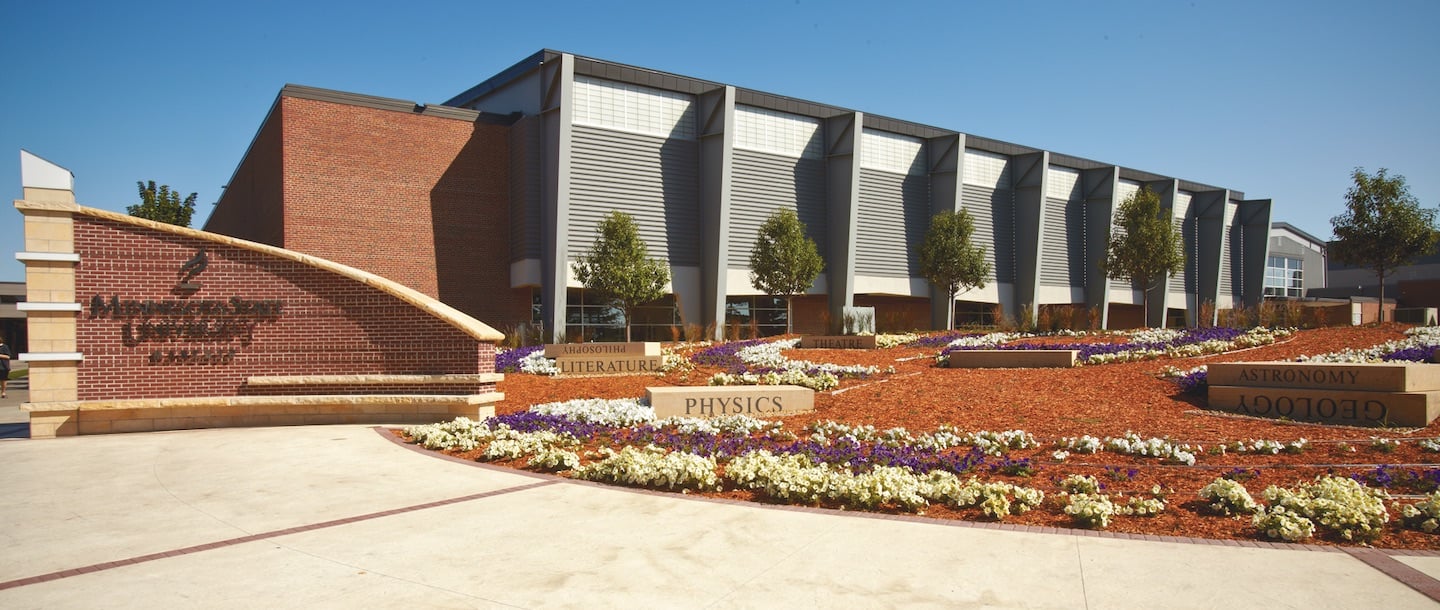
St. Paul sculptor Steven Woodward created this set of eight massive limestone blocks set in grassy berms at the corner of Stadium Road and Ellis Avenue next to the Otto Recreation Center. The amphitheater-like space is a "sculptural landform" as Woodward describes it, and the hulking stones aren't the only clues that it is a work of art. Most of the four-ton blocks are etched with the names of academic disciplines: "Philosophy," "Literature," "Physics," "Theatre," "Astronomy," "Geology," "History." Two of the words - "Philosophy" and "Geology" - are upside down. And one of the stones is blank. Those seeming incongruities have some people asking "Why?" "It's not an in-your-face sculpture. It makes you think. That's the point of an university. The sculptures are foundation blocks, metaphorically reflecting the mission of the university as books nestled within the terraces, and steps and platforms to actively engage the students in a landscape of learning," Woodward explained. The name "Pillars" reflects the students who will physically and conceptually acivate the work," he added. "They are the pillars. The University teaches students to turn a discipline upside down, inside out - to know the discipline thoroughly and from every angle," Woodward said of the inverted words. The blank block represents all of the disciplines that aren't mentioned - "a book open for investigation." |
![]() |
Letterdance
The public artwork located in three separate sites within Highland Center, is called Letterdance and was created to reflect and to enhance the internationally diverse community of Minnesota State University. Letterdance is made of stainless steel, bronze and brass. Letterdance was made by Alexander Tylevich, from Saint Paul who was paid $112,725 for his services, this represents almost 1% of the $11 Million dollar construction costs for the Taylor Center. |
![]() |
The Mankato State University Mace
The Mankato State University Mace has been made entirely from Minnesota materials in recognition of the value and beauty of the state's natural resources and people. A university mace symbolizes both the university's power to overcome ignorance and prejuidice by seeking turth, and the power of the university's president to protect the university and its community from forces opposed to those goals. The mace used in each graduation ceremony was commissioned and donated to Mankato State by Fred and Karin Block. The mace was created by Phil Swan, a Mankato State University alumnus from Prior Lake, Minn.
|